
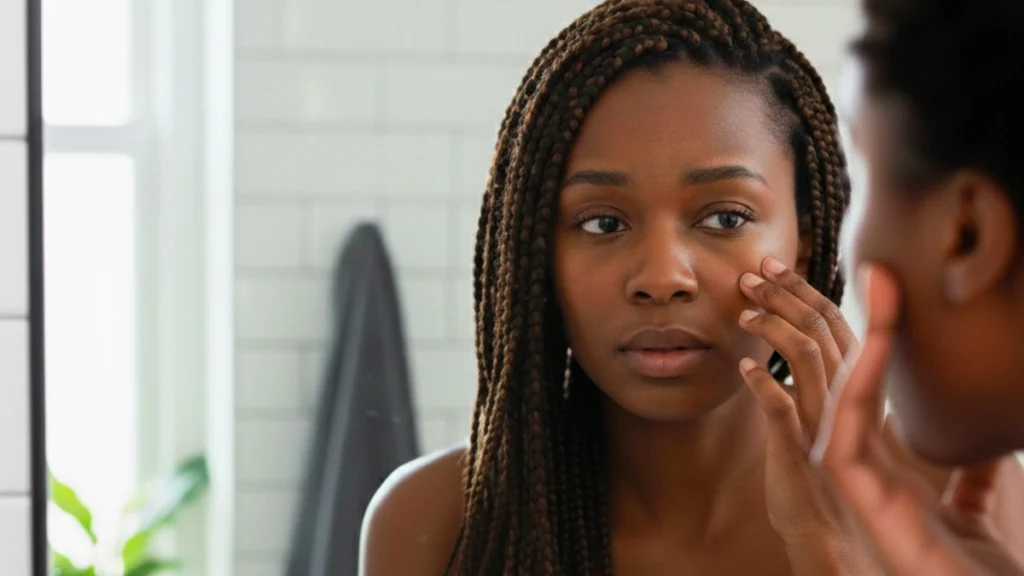
I still remember the exact morning it happened to me. I walked into the bathroom, looked in the mirror under that harsh overhead light, and just… stopped. Something looked different. Not dramatic, not sudden — just different. My under-eyes looked a little hollower, a little more tired, a little more like my mom’s eyes than my own.
I hadn’t changed anything. Same skincare routine. Same sleep schedule. Same diet. And yet, there it was.
I texted my friend Lauren from Chicago right then and there: “Did your under-eyes just change literally overnight after 30 or is it just me?” She responded in about 30 seconds: “Oh my God, YES. I thought I was losing my mind.”
If you’ve had that same moment — that quiet, slightly jarring realization in the mirror — you are not imagining it. And you are absolutely not alone. What you’re experiencing is one of the most common things women in their early 30s describe, and there’s a very real, very explainable reason it happens. Let’s talk about it.
Why Your Under-Eyes Show It First — Before Anything Else
Here’s something most people don’t know: the skin under your eyes is genuinely different from the skin everywhere else on your face. It’s about 40% thinner than the skin on your cheeks or forehead. It has almost no oil glands, which means it can’t self-moisturize. And it moves constantly — you blink somewhere between 15,000 and 20,000 times every single day. That’s a lot of movement in a very thin, very delicate area.
Because of all this, the under-eye area is basically a first-responder zone. When your body starts making subtle changes in collagen production, fat distribution, or hydration retention — and these changes start happening gradually through your late 20s — the under-eyes are the first place to show it. Your cheeks might look completely fine. Your forehead might be totally unchanged. But those under-eyes? They’re already telling the story.
This is why it feels sudden. It’s not that everything happened overnight — it’s that this one area hit a threshold where the changes became visible all at once. Think of it like a slow leak that suddenly becomes a puddle. The leaking was happening for a while. You just didn’t see it until it reached a certain point.
At BelleNora, we hear this from women constantly. And the most important thing we want you to know is: this is not a failure. It’s not a sign that you did something wrong or didn’t take care of yourself. It’s biology — and understanding it is the first step toward actually addressing it.
Want to go even deeper on this? We cover the full science in our detailed guide on why your under-eye skin changes before anything else on your face — it’s worth a read if you want the complete picture.
The Real Reason It Feels Like It Happened Overnight
Your 30s don’t come with a dramatic skincare emergency. What actually happens is much quieter and more gradual — but the effect feels abrupt because awareness tends to arrive all at once.
Starting in your late 20s, a few things begin to shift at the same time. Collagen production slows down by about 1% per year after 25 — which sounds tiny, but adds up. The tiny fat pads under your eyes that keep them looking full and cushioned start to shift position very slightly. And your skin’s ability to hold onto water and bounce back from dehydration becomes a little less efficient.
None of these changes are dramatic on their own. But when they all happen in the same thin, reactive, constantly-moving area? The visual result can feel like it appeared out of nowhere. And when you see it in a selfie or under the bathroom light on a Tuesday morning, it hits differently than you’d expect.
Rachel, 33, from Nashville, told us: “I literally checked if I was getting sick. I thought I was dehydrated or coming down with something. It took me a few weeks to realize it wasn’t going away — my skin had just changed.”
This is incredibly common. And it’s worth saying clearly: what changed is not just your skin. It’s also how light interacts with it. As volume shifts — even slightly — light hits the under-eye area differently. Shadows land in new places. The hollows catch light in ways they didn’t before. Sometimes what looks like dramatic aging is actually just your face at a slightly different angle under slightly different lighting than you’re used to.
What Stress and Sleep Are Actually Doing to Your Under-Eyes
Here’s the thing about stress that most skincare articles won’t tell you: it’s not just about feeling tired. Chronic stress raises cortisol levels in your body, and cortisol directly affects your skin’s ability to repair itself overnight. It also messes with your sleep quality — not necessarily the number of hours you get, but how deeply you sleep and how effective your body’s overnight repair cycle actually is.
The under-eye area is particularly sensitive to this because it has so little structural support. Thicker skin on your cheeks can handle a few rough nights without showing much. Your under-eyes? They show it almost immediately — puffiness, hollowness, that exhausted look that just won’t quit no matter how much concealer you pile on.
Megan, 31, from Seattle, shared: “I’m getting the same amount of sleep I always have — 7 hours. But since I started a new job last year, my eyes look so much more tired. My dermatologist told me it’s stress affecting my sleep quality, not the hours.”
If you want to understand exactly how stress affects your skin — especially in colder months when everything compounds — our guide on how stress affects your skin in winter breaks it all down really clearly.
This is a really important distinction. If you’re doing everything right — getting your 7–8 hours, drinking water, eating reasonably well — and your under-eyes still look rough, stress and cortisol are worth looking at seriously. Meditation, reducing screen time before bed, and even just going to sleep at the same time every night can make a bigger difference to your under-eyes than a lot of expensive eye creams.
Dark Circles, Hollowness, Fine Lines — These Are NOT the Same Thing
One of the biggest mistakes women make with under-eye care is treating every concern the same way. Your under-eyes might be dealing with dark circles. Or hollowness. Or fine lines. Or puffiness. Or all four at once. But each of these has a different cause — and responds to different ingredients and approaches.
Here’s a quick breakdown so you can actually identify what you’re dealing with:
|
Under-Eye Concern |
What’s Actually Causing It |
What Helps |
|
Dark Circles |
Blood vessels showing through thin skin, or pigmentation from sun exposure |
Caffeine eye creams, Vitamin C, SPF every morning |
|
Hollowness / Sunken Look |
Natural fat and volume shifting as collagen slows down |
Hyaluronic acid serums, staying well hydrated, sleep |
|
Fine Lines & Crepey Skin |
Dehydration + slower cell turnover, not true deep wrinkles yet |
Peptide eye creams, gentle retinol, rich moisturizer |
|
Puffiness in the Morning |
Fluid pooling overnight, allergies, sodium, or poor sleep quality |
Cold compress, caffeine eye cream, sleeping elevated |
|
Tired Look Even When Rested |
Light hitting hollows differently as volume shifts subtly |
Brightening eye cream, Vitamin C serum, concealer tricks |
Why does this matter? Because buying a “dark circle cream” when your problem is actually hollowness isn’t going to help — and it might make you feel like skincare doesn’t work at all, when really you just needed a different tool. Identifying the actual concern first is everything.
Fine lines in particular are often misread as aging when they’re actually dehydration. We go deep on this in our article on under-eye skin dehydration after 30 — it might completely change how you look at your under-eyes.
What Skincare Can Actually Do — And What It Can’t
I want to be real with you here, because I think a lot of women get disappointed with skincare not because the products don’t work — but because they expected them to do something they were never designed to do.
Good skincare for your under-eyes absolutely can improve hydration, which reduces the look of fine lines and crepey texture. It can strengthen your skin barrier over time, making the area more resilient. It can brighten pigmentation with consistent use of Vitamin C and niacinamide. It can reduce morning puffiness with caffeine-based formulas. These are real, meaningful improvements.
What it cannot do is replace lost structural volume. If hollowness is your main concern, no eye cream in the world is going to fill that in — that’s structural, and it requires a different conversation with a dermatologist if it really bothers you. Skincare also can’t reverse genetic predispositions to dark circles caused by the way your blood vessels sit under your skin.
Understanding this isn’t depressing — it’s actually freeing. When you know what your products can realistically deliver, you stop chasing miracles and start building a routine that works. And that’s when you actually start seeing results.
Why Doing Less Is Often the Answer After 30
This one surprised me when I first heard it from a dermatologist — but it makes complete sense once you understand the science. After 30, the under-eye area becomes more reactive, not less. Which means throwing more products at it is often the exact wrong move.
Strong actives like high-concentration retinol, harsh exfoliants, or heavily fragranced creams can actually compromise the skin barrier in this area — leaving it more irritated, more dehydrated, and more visibly aged than before you started. I’ve heard from so many women who said their skin actually got better when they stripped their routine back to three or four products instead of ten.
The goal isn’t to do nothing — it’s to be intentional. A gentle cleanser, a hydrating eye cream with peptides, a Vitamin C serum in the morning, and SPF. That’s genuinely enough for most women in their 30s. Consistent and simple will always beat complicated and aggressive.
If you want the full list of what to stop doing immediately, our article on the most common under-eye skincare mistakes after 30 is one of our most-read pieces — because so many women recognize themselves in it.
A Simple Daily Routine That Actually Protects Your Under-Eyes
Here’s what a realistic, effective under-eye focused routine looks like — morning and night:
|
Time |
Step |
Why It Matters |
|
Morning |
Splash cold water on eyes, gently pat dry |
Reduces overnight puffiness, wakes up circulation |
|
Morning |
Apply eye cream with ring finger — tap, never rub |
Ring finger has least pressure — protects delicate skin |
|
Morning |
Vitamin C serum on face (avoid direct eye contact) |
Brightens, protects from UV damage all day |
|
Morning |
SPF 30+ on face including brow bone area |
UV is the #1 cause of under-eye aging — non-negotiable |
|
Night |
Remove makeup gently — no rubbing, no tugging |
Repeated friction breaks down collagen over time |
|
Night |
Apply peptide or retinol eye cream — ring finger only |
Overnight is when skin repairs and rebuilds |
|
Night |
Sleep on your back if possible, or silk pillowcase |
Reduces compression lines and morning puffiness |
One tip that sounds small but makes a real difference: always use your ring finger when applying anything around the eyes. It naturally applies the least pressure of any finger. Dragging or rubbing with your index finger — especially when removing makeup — causes repeated micro-trauma to that thin skin over time. It adds up more than you’d think.
If the seasons affect your skin routine — especially during colder months — check out our complete Christmas & winter skincare routine for USA women which covers how to adjust your under-eye care when temperatures drop.
And if winter is leaving your face feeling raw and flaky on top of under-eye concerns, our guide on how to fix extremely dry skin on your face in winter has everything you need to rebuild your barrier fast.
Daily Habits That Protect Your Under-Eyes More Than Any Cream
I know this section sounds like generic wellness advice — but hear me out, because these habits genuinely show up in your skin in ways that are hard to replicate with products alone:
- Sleep timing matters more than sleep hours: Going to bed at a consistent time every night allows your body’s cortisol and repair cycles to sync properly. Women who sleep 6.5 hours at the same time every night often have better-looking skin than women who sleep 8 hours at wildly inconsistent times.
- Reduce eye strain from screens: Squinting — even subconsciously — causes repeated muscle contractions around the eyes that contribute to fine lines over time. The 20-20-20 rule (every 20 minutes, look 20 feet away for 20 seconds) sounds small but protects the eye area more than most people realize.
- Stay ahead of dehydration: The under-eye area shows dehydration faster than anywhere else on your face. Before you blame aging, make sure you’re actually drinking enough water throughout the day. A lot of “fine lines” in your 30s are actually dehydration lines that plump back up with proper hydration.
- Gentle makeup removal every single night: Never go to sleep in eye makeup. And never scrub it off aggressively. Use a gentle micellar water or cleansing balm, let it dissolve the makeup, and wipe gently. Repeated aggressive rubbing around the eyes is one of the most underrated causes of premature under-eye aging.
Especially during the holiday season when you’re wearing heavier makeup — this habit becomes even more important. Our guide on what not to do to your skin during Christmas week covers exactly which habits to break before they cause real damage.
- Cold compress in the morning if you’re puffy: Keep a clean spoon in the freezer, or use cold green tea bags. 2 minutes under your eyes in the morning can visibly reduce puffiness. It’s old-school, it’s free, and it genuinely works.
Your Under-Eye Questions, Answered Honestly
Q1. Is it normal for under-eye changes to appear suddenly in my early 30s?
Completely normal — and incredibly common. The changes themselves are gradual, but the awareness often arrives all at once. Your under-eye skin is the thinnest on your face, which means it shows cumulative changes before anywhere else. You’re not imagining it, and you’re definitely not alone. Most women in their early 30s experience exactly this moment of sudden awareness.
Q2. My dark circles are getting worse even though I sleep fine. Why?
Dark circles aren’t always about sleep — that’s actually a common myth. There are a few different types of dark circles. Some are caused by pigmentation (sun damage, genetics). Some are caused by blood vessels becoming more visible as skin thins. And some are caused by hollowness creating a shadow effect. If you’re sleeping fine and still have dark circles, look at your hydration levels, your sun protection habits, and whether the issue might actually be subtle hollowness rather than true pigmentation.
For pigmentation-related dark circles, niacinamide is one of the most effective ingredients you can use. Check out our roundup of the best niacinamide serums for pores and oil control — many of these work beautifully for brightening the under-eye area too.
Q3. Can I use my regular face moisturizer around my eyes to save money?
You can — but it’s not ideal. Regular face moisturizers are often formulated with ingredients that are fine for thicker facial skin but can be too heavy or too active for the under-eye area, potentially causing milia (those tiny white bumps) or irritation. A dedicated eye cream is usually lighter, more specifically formulated for that delicate zone, and worth the investment. That said, if budget is tight, a tiny amount of a simple, fragrance-free face moisturizer is better than nothing.
Q4. Should I start using retinol under my eyes in my 30s?
Yes — but very carefully and with a formula specifically made for the eye area. Regular retinol serums or creams are usually too strong for the under-eye skin and can cause serious irritation. Look for an eye cream that contains a low concentration of retinol or retinyl palmitate (a gentler derivative). Start once or twice a week, always follow with a rich moisturizer, and never use it near your actual eyelid — just on the orbital bone below the eye.
Q5. Are eye creams actually worth it or is it just marketing?
Honestly — it depends on the eye cream. A lot of them are overpriced moisturizers in a tiny jar. But the good ones contain targeted ingredients like caffeine (for puffiness), peptides (for firmness), hyaluronic acid (for hydration), and Vitamin C or niacinamide (for brightening) in formulas specifically designed for the delicate eye area. Look for those ingredients on the label rather than paying for a brand name. You don’t need to spend $80 on an eye cream to get real results — some of the best ones are under $25.
Q6. Will drinking more water actually help my under-eyes?
Yes — more than most women realize. Dehydration shows up dramatically in the under-eye area. Fine lines that look like aging in the morning often plump back up significantly with proper hydration throughout the day. Before you invest in a new eye cream, spend two weeks drinking at least 8 glasses of water a day and see what changes. You might be surprised. Hydration from the inside works differently than hydration from a cream — and both matter.
We actually wrote an entire guide specifically on this because it comes up so often — under-eye skin dehydration after 30: what it really looks like and how to fix it — it’s one of the most eye-opening reads for women who think they’re dealing with aging when it’s actually dehydration.
Q7. Can stress really make my under-eyes look worse even if I’m sleeping?
Absolutely — and this is really underappreciated. Chronic stress raises cortisol, which disrupts the quality of your sleep even if the quantity seems fine. It also affects circulation, fluid balance, and your skin’s overnight repair process. All of these show up specifically in the under-eye area because of how thin and reactive the skin is there. Managing stress is genuinely a skincare strategy — not just a wellness buzzword.
Q8. Is hollowness under my eyes something skincare can actually fix?
Partially. Skincare can improve the look of hollowness by maximizing hydration and plumping the skin as much as possible — hyaluronic acid serums are the best tool for this. But true structural hollowness caused by fat pad shifting is not something a cream can reverse. If hollowness is significantly bothering you and skincare isn’t making enough of a difference, it’s worth having a conversation with a board-certified dermatologist about options. Filler is a medical procedure, but it’s worth knowing the option exists.
Q9. I’ve started wearing more concealer to cover my under-eyes. Is that making it worse?
The concealer itself isn’t the issue — but how you apply and remove it might be. Dragging concealer on or off with repeated friction is a real problem for that delicate skin. Use a damp beauty sponge to gently press concealer into place rather than rubbing. And when removing it at night, always use a gentle micellar water and let it dissolve rather than scrubbing. The less friction around your eyes, the better — consistently.
If you want the complete list of habits that are quietly aging your under-eyes without you realizing it, our guide on the most common under-eye skincare mistakes after 30 will genuinely surprise you — most women recognize at least 3 or 4 things they’re doing wrong.
Q10. At what point should I see a dermatologist about my under-eyes?
If home skincare isn’t making a noticeable difference after 3–4 months of consistent use, or if you’re bothered enough by the changes that it’s affecting your confidence, a dermatologist visit is absolutely worth it. They can identify whether your concern is pigmentation, structural, or hydration-based, and recommend targeted treatments — from prescription-strength ingredients to professional procedures — that go beyond what over-the-counter products can do. There’s no shame in asking for expert help.
The Bottom Line — From BelleNora
Here at BelleNora, we believe that understanding your skin is always more powerful than just throwing products at it. Under-eye aging after 30 is real, it’s common, and it makes complete biological sense. It doesn’t mean you’ve done something wrong. It doesn’t mean you’re declining. It means your skin is changing — and now you get to be intentional about how you take care of it.
The women who feel best about their skin in their 30s and beyond aren’t the ones using the most products or the most expensive ones. They’re the ones who understood what was actually happening, built a simple and consistent routine, set realistic expectations, and stopped fighting their skin and started working with it.
That’s what we’re here to help you do. One honest conversation at a time.
Your under-eyes don’t need to be perfect. They just need to be taken care of — gently, consistently, and with a little more knowledge than you had before you started reading this.