
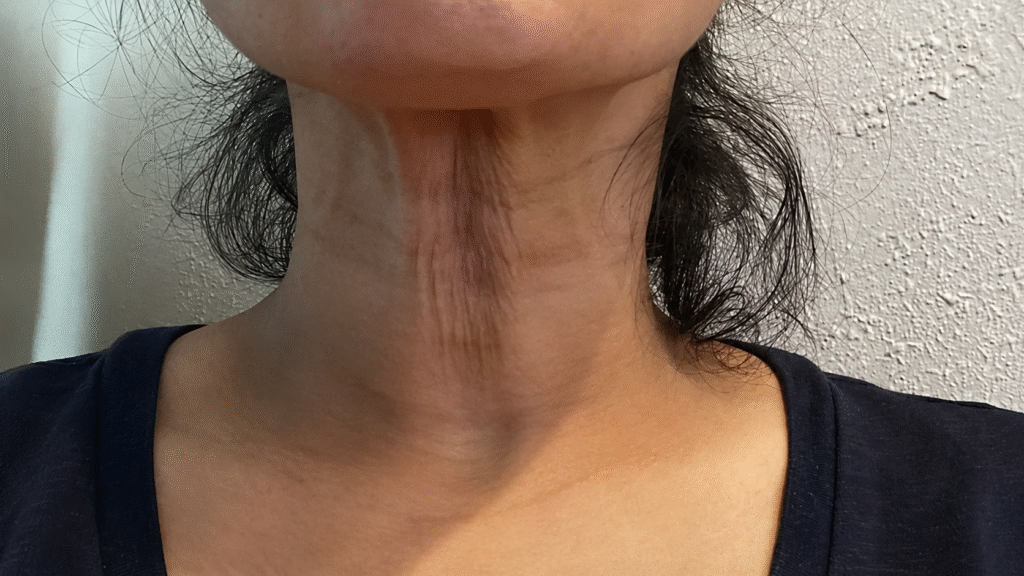
I remember the exact moment I noticed it.
It was a Tuesday morning. I was getting ready for work, half-asleep, scrolling through my phone with one hand while the other reached for my moisturizer. I glanced up at the mirror — and then I really looked.
My neck. It looked… crinkled. Like someone had gently scrunched up a piece of tissue paper and smoothed it back out, but not quite all the way.
I was 42.
I put down my phone. I stood there for a solid two minutes just staring. And then, like every woman who has ever had a skin panic at 6 AM, I went straight to the internet.
What I found was either terrifying (forums saying nothing works, you’re aging, accept it) or completely useless (ads for $400 creams that promised to “reverse time”). What I didn’t find was someone just talking to me like a normal person about what crepe skin actually is, why it happens, and what you can realistically do about it.
So that’s what I’m going to do here.
What Is Crepe Skin, Actually?
Crepe skin is exactly what it sounds like — skin that looks thin, slightly loose, and textured, similar to crepe paper. It tends to show up first on the neck, chest, upper arms, and around the eyes.
It happens because of a combination of things:
Collagen loss. Starting in your mid-30s, collagen production gradually declines. By your 40s, that loss becomes visible. According to the American Academy of Dermatology, this is one of the primary drivers of visible skin aging in women over 40.
Elastin breakdown. Along with collagen, elastin — the protein that helps skin stretch and return to shape — starts to degrade. UV exposure accelerates this significantly.
Hormonal shifts. Declining estrogen levels affect how much moisture your skin naturally retains. The Cleveland Clinic notes that skin changes during perimenopause are among the most common concerns dermatologists hear from women in their 40s.
Decades of sun exposure. UV rays break down collagen and elastin far faster than age alone. The NIH’s National Institute on Aging confirms that photoaging is responsible for the majority of visible skin changes in older adults.
The neck is especially vulnerable because most of us have been moisturizing and protecting our faces for years while completely ignoring everything below the jawline.
Quick Reference: Why Crepe Neck Happens After 40
| Cause | What Happens | How Fast |
| Collagen loss | Skin loses firmness and bounce | Gradual from mid-30s |
| Elastin breakdown | Skin can’t snap back | Accelerated by UV |
| Estrogen decline | Less moisture retention | Perimenopause onwards |
| Sun exposure | Photoaging, collagen damage | Decades of cumulative damage |
The Truth About What Works (And What Doesn’t)
Let me save you the several hundred dollars I spent figuring this out.
What doesn’t work:
- Any cream promising “instant tightening.” That’s usually just a film-forming ingredient creating a temporary taut sensation. It washes off.
- Expensive “collagen-boosting” supplements with no peer-reviewed evidence behind them.
- Aggressive scrubbing or exfoliating. Crepe skin is already fragile — harsh exfoliation makes the texture worse, not better.
- Ignoring it and hoping it resolves on its own. It won’t.
What does work:
1. Sunscreen — Every Single Day, On Your Neck
If you’re currently applying sunscreen on your face and stopping at your jaw, this is the first thing to change. The neck sees as much sun as the face does, sometimes more, and it almost never gets protected.
Broad-spectrum SPF 30 minimum. SPF 50 is better. Apply it to your neck and chest every morning, year-round. For dry or mature skin types, look for sunscreens with added humectants. The best sunscreens for dry skin in 2026 covers options that sit beautifully on the neck without feeling greasy or cakey. If your skin has become more sensitive, check out sensitive skin sunscreens that actually work — no sting, no white cast.
2. Retinol — The One Ingredient Worth Committing To
Retinol has more clinical backing than almost any other topical ingredient for improving skin texture and stimulating collagen production. It’s not a miracle, but it’s the closest thing we have in a bottle.
On the neck specifically, start lower and slower than you would on your face — the skin there is thinner and more prone to irritation. A 0.025% to 0.1% concentration, applied every other night, is a good starting point.
Most women notice visible texture improvement after 12 to 16 weeks of consistent use. If you’ve never used retinol before, the beginner’s guide to retinol serums walks through how to introduce it safely. For those already in their 40s, retinol after 30 covers exactly what changes and why.
3. Hyaluronic Acid — Hydration Your Skin Can Actually Use
Crepe skin is, at its core, dehydrated skin. Even women who drink plenty of water notice that their skin holds less moisture after 40 — that’s because the skin’s own hyaluronic acid production decreases with age.
Apply it immediately after cleansing, while your skin is still slightly damp — this is what makes it actually work. Seal it in with a moisturizer right after. Look for multi-weight hyaluronic acid — it works at different skin depths rather than just sitting on the surface.
4. A Moisturizer That Does More Than Hydrate
After 40, a basic lotion isn’t enough for the neck. You want a moisturizer that actively supports your skin barrier. The four ingredients worth looking for:
- Ceramides — rebuild and strengthen the skin barrier
- Peptides — send collagen-production signals to your skin cells
- Squalane or shea butter — nourishing lipids that mimic the skin’s own oils
- Niacinamide — improves skin elasticity and helps even out texture
Avoid moisturizers with high alcohol content or synthetic fragrance — both are irritating on the already-sensitive neck area.
5. Vitamin C in the Morning
Vitamin C applied topically neutralizes free radical damage from UV and pollution, and it supports collagen synthesis. Used every morning before sunscreen, it adds meaningful protection and — over several months — noticeably brightens and firms skin tone.
Look for L-ascorbic acid in a dark or opaque bottle at around 10 to 20% concentration. Apply it before your hyaluronic acid, on clean dry skin. Give it 60 seconds to absorb before layering.
6. How You Apply Everything Matters
Always apply products to your neck using upward strokes. Repeated downward pulling on already-lax skin can gradually worsen the problem. Use your full palm or light fingertip pressure — never drag.
Whatever you’re doing on your face, extend it to your neck and chest. If you’re applying retinol to your face and stopping at your chin, your neck is missing the one thing that would actually help it most.
Key Ingredients at a Glance
| Ingredient | What It Does | When to Use | Time to See Results |
| Sunscreen SPF 50+ | Prevents further UV damage | Every morning | Immediate protection |
| Retinol 0.025–0.1% | Boosts collagen, improves texture | 3x per week, night | 12–16 weeks |
| Hyaluronic Acid | Deep hydration, plumping | Morning & night | 2–3 days |
| Ceramide Moisturizer | Repairs skin barrier | Morning & night | 1–2 weeks |
| Vitamin C 10–20% | Antioxidant, brightening | Every morning | 4–8 weeks |
| Peptides | Signals collagen production | Morning or night | 8–12 weeks |
My Actual Morning and Night Routine
This is what I do now, after a lot of trial, error, and money spent:
Morning:
- Gentle, fragrance-free cleanser
- Vitamin C serum — face and neck
- Hyaluronic acid while skin is still slightly damp
- Ceramide and peptide moisturizer
- SPF 50 — face, neck, and chest
Night:
- Oil cleanser first (especially important if you’ve worn sunscreen)
- Gentle second cleanser
- Retinol on face and neck — 3 nights a week
- On non-retinol nights: peptide serum or a barrier repair formula
- Richer moisturizer than the morning version
Understanding how to layer your serums correctly makes a bigger difference than most people expect — order genuinely matters.
Lifestyle Factors That Affect Your Neck More Than You’d Think
Skincare products are only part of this. These factors directly influence how fast skin ages:
Sleep position. Sleeping on your side or stomach with your face pressed into a pillow repeatedly compresses and creases the neck skin. Silk pillowcases reduce friction. Sleeping on your back, even occasionally, helps.
Hydration. Two liters of water daily is a minimum. Your skin reflects your internal hydration, especially on thinner areas like the neck.
Stress. Elevated cortisol from chronic stress actively breaks down collagen. The connection between stress and skin is well-documented and worth paying attention to.
Smoking. Cigarette smoke is one of the fastest ways to break down collagen and elastin. The effects are not reversible with topical products.
Diet. Antioxidant-rich foods (berries, leafy greens, nuts), omega-3s (salmon, flaxseed, walnuts), and vitamin C all support collagen production from the inside. Ultra-processed foods and excess sugar accelerate glycation — a process that degrades collagen fibers.
When Topicals Aren’t Enough
If you’ve been consistent with a good routine for 6 months and aren’t seeing the improvement you’re looking for, professional treatments are worth exploring:
Microneedling creates controlled micro-injuries that trigger the skin’s natural collagen response. A series of 3 to 4 sessions, spaced about a month apart, is typically recommended.
Radiofrequency treatments (Thermage, Morpheus8) deliver heat energy into deeper skin layers to stimulate collagen and physically tighten existing fibers. These are among the most effective non-surgical options for the neck.
Ultrasound treatments (Ultherapy) work at a deeper level and produce a noticeable lifting and firming effect. Results appear gradually over 2 to 3 months.
None of these are permanent, and none are cheap. But if you’re looking for results beyond what a serum can achieve, a consultation with a board-certified dermatologist is worthwhile.
Professional Treatments Compared
| Treatment | How It Works | Sessions Needed | Results Timeline |
| Microneedling | Micro-injuries trigger collagen | 3–4 sessions | 4–8 weeks after last session |
| Radiofrequency (Thermage / Morpheus8) | Heat tightens collagen fibers | 1–3 sessions | 2–6 months |
| Ultrasound (Ultherapy) | Deep heat stimulates new collagen | 1–2 sessions | 2–3 months |
FAQ
Can you actually reverse crepe skin on the neck, or only slow it down?
Honestly, both. You can’t fully undo decades of aging, but “reverse” is a fair word for what retinol and peptides can do with consistent use. Many women see genuinely significant improvement in how the skin looks and feels. Prevention will always be more powerful than correction, but it is never too late to start.
How long does it realistically take to see results?
Retinol: 12 to 16 weeks before visible texture improvement. Hyaluronic acid and moisturizer: you’ll feel a difference within a few days. Vitamin C: 4 to 8 weeks for brightening. The timeline that trips most people up is retinol — they quit at week 6, right before the 12-week mark when it typically kicks in.
Is retinol safe to use on the neck?
Yes, with modifications. The neck skin is thinner and more reactive than your face, so start at a lower concentration and apply less frequently — every other night to start. Always follow with moisturizer.
My skin has become much more reactive since my early 40s. What’s going on?
This is extremely common and directly tied to hormonal changes. As estrogen declines, the skin barrier becomes less robust. Prioritize barrier repair first — ceramide moisturizer, gentle cleanser, nothing harsh. The skin barrier repair guide is the right starting point.
Do I need a dedicated neck cream, or can I just extend my face products?
You can absolutely extend your face products — and that’s genuinely what most dermatologists recommend. If your face routine already includes retinol, peptides, SPF, and a ceramide moisturizer, you don’t need a separate product. Just bring everything down past the jawline.
I’m in my late 40s and haven’t done any of this. Is it too late?
No. Skin responds to the right care regardless of when you start. Start with sunscreen and a basic moisturizer if you’re overwhelmed. Add retinol when you’re ready. Give it six months. You will see a difference.
The morning I noticed my crepe neck, I felt a little sad. I won’t pretend otherwise. But what I’ve learned since then is that the solution isn’t a $400 miracle cream. It’s consistent, boring, daily care with ingredients that actually work.
Sunscreen. Retinol. Hydration. Patience.
Your neck has been with you through everything. It’s not too late to take care of it.
Questions about building a routine for aging neck and chest skin? Leave them in the comments — I read every one.

Jessica Brooks is a Brooklyn-based skincare writer and beauty researcher with 5+ years of experience personally testing and reviewing skincare products. She specializes in helping real women find SPF, serums, and routines that actually work for their skin type.