
By Jessica Brooks | Updated: Summer 2026
Many people with acne-prone skin skip sunscreen for years. Every. Single. Summer. When skin is already dealing with breakouts, dark spots, and an oily T-zone, the last thing anyone wants is a product that makes things worse. Plenty of sunscreens feel greasy by mid-morning or leave a chalky cast, so SPF gets dropped.
That tends to backfire. Skipping sunscreen can make post-acne marks darker and more persistent, and UV exposure can leave inflamed, reactive skin even more irritated. A careful nighttime routine can be undone each morning by stepping outside without SPF.
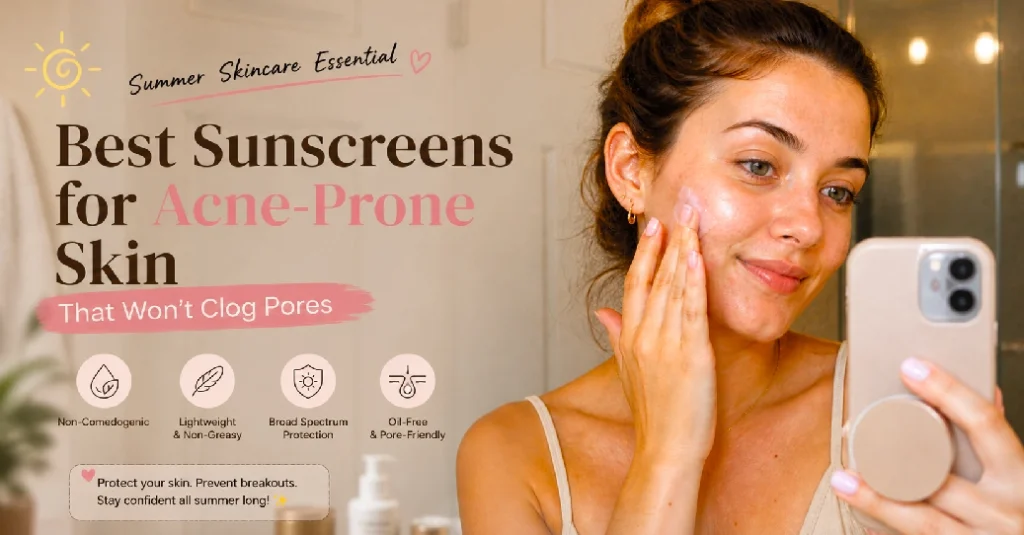
The good news is that a sunscreen doesn’t have to clog pores or leave an oil slick. This guide covers what to look for, which ingredients to be cautious about, and six well-reviewed options for oily, combination, and acne-prone skin. The picks are based on ingredient lists, dermatologist recommendations, and user reviews, and the guide is updated for Summer 2026.
Why Your Skin Needs Sunscreen (Even If It Breaks You Out)
It sounds like a trap, but a sunscreen that caused breakouts was most likely the wrong formula, not sunscreen itself. There is a big difference.
What can happen when acne-prone skin goes unprotected in the sun:
- Post-acne dark spots (hyperpigmentation) get darker and take longer to fade
- UV exposure can trigger inflammation, which can mean more breakouts
- Sun damage speeds up collagen breakdown, which leads to early fine lines
- If you use retinol, BHAs, or benzoyl peroxide, your skin can be more sensitive to the sun, so SPF matters even more (new to retinol? See the beginner’s guide to retinol serums)
The bottom line: SPF isn’t optional, even for acne-prone skin. The goal is the right kind of sunscreen: one formulated not to clog pores.
Good to know: Daily SPF is one of the most effective ways to keep post-acne dark spots from deepening. Fading existing marks usually takes weeks to months, and results vary from person to person.
What to Actually Look for in a Sunscreen for Acne-Prone Skin
Shopping for acne-prone skin can feel like navigating a minefield. Here is what to look for, and what to avoid.
The Must-Haves
- Non-comedogenic formula: This means the product is formulated not to clog pores. The term isn’t strictly regulated, so treat it as a helpful signal rather than a guarantee, and patch test new products.
- Oil-free base: Water-based or gel formulas absorb quickly and tend to leave less residue, which many people prefer in summer.
- The right moisturizer underneath: Sunscreen works best on a healthy skin barrier. Not sure what to use under it? See the best moisturizers for combination skin in 2026.
- Broad-spectrum protection: This covers both UVA (aging rays) and UVB (burning rays). Both matter every day.
- SPF 30 at minimum: The American Academy of Dermatology recommends broad-spectrum SPF 30 or higher. For long periods outdoors, SPF 50+ is a common choice.
Mineral vs. Chemical: Which Is Better for Acne?
It is one of the most common questions, and the honest answer is that both can work.
Mineral sunscreens use zinc oxide or titanium dioxide to physically block UV rays. They tend to be gentler and better tolerated by sensitive, reactive skin. The downside is that some leave a white cast, although many newer formulas have improved. (If white cast is your biggest concern, see the best sunscreens for dark skin with no white cast.)
Chemical sunscreens absorb UV rays and convert them to heat. They tend to be lighter and invisible on skin. Some people find certain filters irritating (oxybenzone and avobenzone are often mentioned), but many chemical sunscreens work well for acne-prone skin.
Rule of thumb: if chemical sunscreens have never bothered your skin, either type is fine. If your skin is sensitive or reactive, start with mineral.
Ingredients to Be Cautious About
These ingredients are commonly reported to clog pores or irritate acne-prone skin. Reactions are individual, so patch test anything new.
- Coconut oil: often rated highly comedogenic
- Isopropyl myristate: often flagged as pore-clogging
- Fragrance and parfum: a common irritant that can inflame reactive skin
- Very rich, oily, or heavily occlusive formulas: some people find these feel heavy and worsen breakouts; response varies
- Alcohol denat. in high amounts: can dry out and irritate skin
Bonus Ingredients That May Help Acne-Prone Skin
Some sunscreens go further. Look for ingredients such as:
- Niacinamide: may help with oil control, redness, and the look of dark spots
- Hyaluronic acid: hydrates without adding oil
- Centella asiatica (cica): commonly used to soothe irritated skin
- Salicylic acid (low concentration): helps keep pores clear
- Green tea extract: an antioxidant with soothing properties
The Best Sunscreens for Acne-Prone Skin: Summer 2026
These picks are based on ingredient lists, dermatologist recommendations, and user reviews. They come up often for oily, combination, and acne-prone skin. Formulas and prices change, so check the current label before buying.
1. EltaMD UV Clear Broad-Spectrum SPF 46: The Dermatologist Favorite
EltaMD UV Clear is one of the sunscreens dermatologists recommend most often for acne-prone and rosacea-prone skin. The brand lists 5% niacinamide to help with redness and oil, and the finish is transparent and layers well under makeup. It is fragrance-free and oil-free.
- Type: Chemical + mineral (zinc oxide)
- Finish: Matte, skin-like
- Best for: Sensitive, acne-prone, rosacea-prone skin
- Price: $$ (approx. $35–$40)
2. La Roche-Posay Anthelios Clear Skin SPF 60: Best for Hot and Humid Days
Summer heat and oily skin are a tough combination, and this formula is made for it. Anthelios Clear Skin has a dry-touch finish that helps absorb excess oil through the day, so there is less midday blotting. SPF 60 is reassuring for long days outdoors. It is oil-free and labeled non-comedogenic. Check the label for current water-resistance details.
- Type: Chemical
- Finish: Dry-touch, matte
- Best for: Oily, combination, acne-prone skin
- Price: $$ (approx. $33–$38)
3. Neutrogena Clear Face Liquid Sunscreen SPF 55: Best Budget Pick
Not everyone wants to spend $40 on sunscreen. Neutrogena Clear Face is a drugstore option formulated for acne-prone skin: oil-free and light enough to forget you are wearing it. It isn’t the most luxurious texture, but it does the job, and it is easy to find at stores like CVS, Walgreens, and Target.
- Type: Chemical
- Finish: Lightweight, slightly skin-like
- Best for: Everyday use, budget-conscious shoppers
- Price: $ (approx. $14–$18)
4. Supergoop! Unseen Sunscreen SPF 40: Best Under Makeup
Supergoop! Unseen has a clear, gel-like texture that rubs in and leaves no white cast. It also works as a smoothing makeup primer, which makes it popular with people who wear makeup daily and struggle with pilling. It is a bigger investment. The formula has a silicone-like glide, so patch test first if your skin is sensitive to heavier textures.
- Type: Chemical
- Finish: Invisible, velvety-matte
- Best for: Under makeup, oily and combination skin
- Price: $$$ (approx. $42–$48)
5. ISDIN Eryfotona Actinica SPF 50+: Best Mineral Option
If you prefer mineral-only sunscreen, ISDIN’s fluid, almost water-like texture is designed to blend without a heavy white cast. The brand also lists DNA Repairsomes (photolyase enzymes) in the formula. This is a brand claim, and evidence that it reverses existing sun damage is limited, so treat it as a bonus rather than a reason to buy.
- Type: Mineral (zinc oxide)
- Finish: Fluid, non-greasy, minimal white cast
- Best for: Sensitive and acne-prone skin, mineral-only routines
- Price: $$$ (approx. $55–$65)
6. Paula’s Choice Calm Redness Relief SPF 30 Mineral Moisturizer: Best for Sensitive, Acne-Prone Skin
Some acne-prone skin is also sensitive and red, a combination that is hard to shop for. This formula is designed for reactive, redness-prone skin. It has a mineral base with soothing ingredients such as green tea extract. The finish is slightly luminous rather than matte, so it suits dry-to-combination skin better than very oily skin. SPF 30 is a lower number, so reapply when outdoors.
- Type: Mineral
- Finish: Luminous (not matte)
- Best for: Acne with redness and sensitivity
- Price: $$ (approx. $35–$42)
How to Apply Sunscreen Without Causing Breakouts
Even a good non-comedogenic sunscreen can cause problems if it is applied poorly. Here is how to do it right.
Apply on clean, dry skin
Apply sunscreen after cleansing and moisturizing, and before makeup. Layering SPF over leftover dirt or oil can trap it against pores.
Use enough
A common guideline is about a nickel-sized amount for the face. Studies suggest most people use about half of what is needed, which means getting only part of the protection printed on the label. Being generous is fine with a non-comedogenic formula.
Let it absorb first
Give it about 60–90 seconds before applying makeup, especially with mineral formulas. Skipping this step is a common reason foundation looks patchy.
Reapply every two hours in the sun
This is the step many people skip. SPF wears off over time with sun exposure, sweat, and rubbing. A powder SPF or SPF setting spray makes reapplying over makeup easier, although these are best used as top-ups rather than as your only layer of protection.
A simple summer routine: SPF in the morning, then a powder SPF such as Supergoop! Poof Powder SPF 45 for midday touch-ups.
Sunscreen Myths That Are Hurting Your Skin
Myth: Sunscreen is what’s causing my breakouts
This is a very common belief. In most cases, if a sunscreen is breaking you out, the issue is that formula, not sunscreen as a category. Switching to an oil-free, non-comedogenic formula often helps. Don’t give up on SPF; look for a better one.
Myth: You don’t need SPF indoors
UVA rays, the kind linked to pigmentation and aging, pass through windows. Working near a window means UV exposure. This is also one reason skin around the eyes can age faster than expected (see the most common under-eye skincare mistakes women make after 30).
Myth: The SPF in my foundation is enough
To get the SPF printed on a foundation, you would need to apply much more than most people do, often several times the usual amount. Foundation SPF is a nice bonus, but it is not a substitute for sunscreen underneath.
Myth: Darker skin tones don’t need sunscreen
Melanin offers some natural UV protection, but it does not prevent sun damage, hyperpigmentation, or skin cancer. Everyone, regardless of skin tone, benefits from daily SPF.
FAQ: Best Sunscreen for Acne-Prone Skin
Q1: What does non-comedogenic actually mean?
Non-comedogenic means a product is formulated not to clog pores. “Comedones” are clogged pores (blackheads and whiteheads). The term is not strictly regulated, so it is a useful signal rather than a guarantee. It is still one of the most helpful labels to look for in a sunscreen for acne-prone skin.
Q2: Is mineral or chemical sunscreen better for acne-prone skin?
Both can work. Mineral sunscreens (zinc oxide, titanium dioxide) are generally gentler and are often better tolerated by sensitive skin. Chemical sunscreens tend to be lighter and invisible on skin. If you’ve reacted to chemical filters before, try mineral. Otherwise, try both and see which your skin prefers.
Q3: Can sunscreen make acne worse?
The wrong sunscreen can. Formulas with comedogenic ingredients such as coconut oil or very heavy emollients may clog pores for some people. A well-formulated, oil-free, non-comedogenic sunscreen is less likely to. Skipping SPF, on the other hand, tends to make dark marks more stubborn.
Q4: What SPF number should I use?
The American Academy of Dermatology recommends broad-spectrum SPF 30 or higher. SPF 30 blocks about 97% of UVB rays and SPF 50 about 98%, so the jump is smaller than the numbers suggest. Applying enough and reapplying every two hours matters more than the number.
Q5: I use retinol and BHAs. Do I still need sunscreen?
Yes. Retinol, AHAs, BHAs, and benzoyl peroxide can make skin more sensitive, so daily SPF is especially important. Use retinoids at night and sunscreen in the morning. New to retinol? See the beginner’s guide to retinol serums.
Q6: What’s the best sunscreen to wear under makeup?
Look for fast-absorbing formulas with a smooth or matte finish. Supergoop! Unseen Sunscreen SPF 40 and EltaMD UV Clear SPF 46 are both popular under makeup. Let sunscreen absorb for about 60–90 seconds before applying foundation.
Q7: Are gel sunscreens better for oily skin?
Often, yes. Gel and fluid sunscreens are typically lightweight and absorb quickly, so many people with oily skin find them more comfortable in hot weather. Check the ingredient list for pore-clogging ingredients and avoid assuming a gel is automatically non-comedogenic.
Q8: How do I reapply sunscreen over makeup?
Options include SPF setting sprays (such as Coola Refreshing Water Mist SPF 18) and powder sunscreens (such as Supergoop! Poof 100% Mineral Powder SPF 45). Press the product on rather than rubbing, to avoid disturbing your base. These are best as top-ups to a proper first layer.
Q9: Can sunscreen help fade acne marks?
Indirectly. Post-inflammatory hyperpigmentation darkens with sun exposure, so daily sunscreen helps keep marks from deepening while other ingredients, such as vitamin C, niacinamide, or azelaic acid, work over time. Sunscreen alone does not remove existing marks.
Q10: Are there sunscreens that also help with acne?
Some include skin-friendly ingredients. EltaMD UV Clear lists 5% niacinamide, and some formulas contain low levels of salicylic acid. Look for these if you want extra benefit, and patch test first. For persistent or severe acne, a dermatologist can recommend treatments that sunscreen can’t replace.
The Bottom Line
A suitable sunscreen can become one of the most useful steps in an acne-prone skin routine. The right non-comedogenic, oil-free formula is designed to protect skin without clogging pores, and consistent use helps keep dark spots from deepening.
If you want to play it safe, start with EltaMD UV Clear or La Roche-Posay Anthelios Clear Skin, then branch out once you know what your skin tolerates. Wear it every day, not just when it is sunny.
A few more reads that pair with this guide:
- Best Moisturizers for Combination Skin (2026): what to layer under your SPF
- Best Sunscreens for Dark Skin, No White Cast: if white cast has held you back
- Retinol Serums for Beginners: a good nighttime partner for daily SPF
- Under-Eye Skincare Mistakes After 30: your SPF routine should cover this area too
The best sunscreen is the one you will use consistently.
Written by Jessica Brooks | Summer 2026 | For informational purposes only. This content is not medical advice. Always consult a dermatologist for personalized skincare advice.
Sources
- American Academy of Dermatology: guidance on choosing and using sunscreen (aad.org)
- S. FDA: sunscreen information and labeling (fda.gov)
- Zaenglein AL, et al. Guidelines of care for the management of acne vulgaris. J Am Acad Dermatol. 2016;74(5):945–973.
- Each brand’s current product page and ingredient list, checked at publication

Jessica Brooks writes the skincare guides on BelleNora. Her articles are based on published dermatology guidelines, research studies, and product ingredient lists. Content is for education only and is not medical advice.