
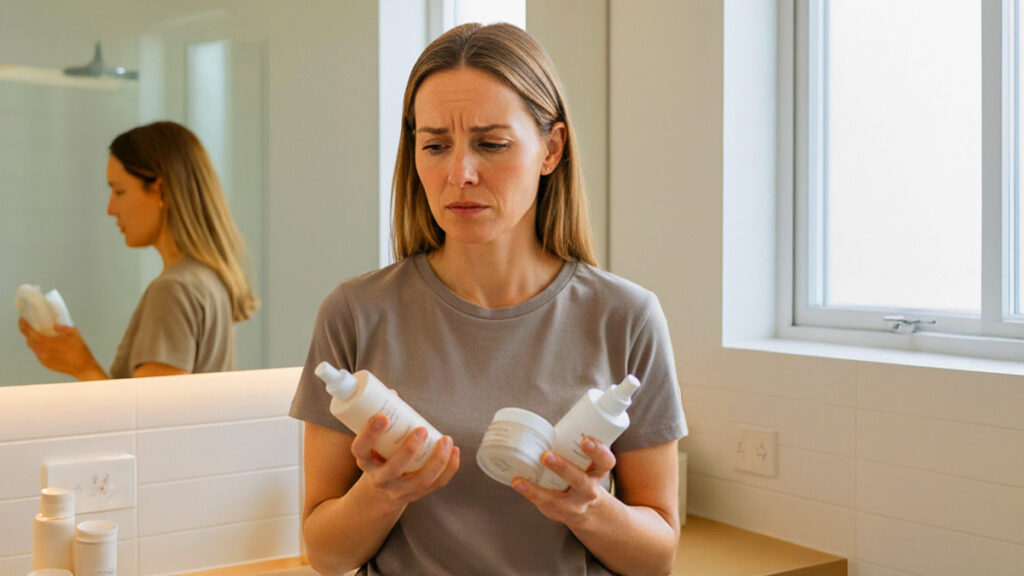
By a real skincare enthusiast who overdid it — and paid the price
Honestly? I used to think that if my under-eyes looked tired or lined, the answer was more. More eye cream. More serum. More tapping, patting, pressing. I had a whole little ritual going — three products, morning and night, convinced I was doing something good.
My under-eyes looked worse at 34 than they did at 28.
And when I finally talked to a dermatologist about it, she said something that stopped me cold: “You’re not neglecting your under-eyes. You’re overwhelming them.”
That one sentence changed everything for me — and if you’re reading this, it might change things for you too.
After 30, the under-eye area becomes a completely different kind of skin to manage. What worked in your 20s can quietly work against you now. And the biggest mistake most women make isn’t laziness — it’s doing too much with the wrong things.
Why Your Under-Eye Skin Changes So Much After 30
Here’s something most skincare brands won’t tell you upfront: the under-eye area was always your most delicate skin. It’s thinner than the rest of your face, it has almost no oil glands, and it sits over a constant web of tiny blood vessels and movement. Every expression you make — every smile, squint, laugh — happens right there.
After 30, collagen production starts slowing down. Skin cell renewal takes longer. The fat pads beneath the eyes begin to shift slightly. These are natural, biological changes — and understanding them matters because it changes how you should be caring for this area.
If you want a deeper look at exactly what’s happening structurally under your eyes as you age, this breakdown of under-eye aging after 30 covers it really well.
The short version: after 30, this skin needs gentleness and consistency — not power and aggression.
Why Doing More Often Makes Under-Eyes Look Worse
This is the part that surprises most women.
Unlike the rest of your face, your under-eye skin doesn’t have the resilience to bounce back from repeated irritation. When you overload it — too many products, too many actives, too much rubbing — it doesn’t repair itself quickly. Instead, it responds with something called increased transepidermal water loss. In plain terms: it starts losing moisture faster than it can replace it.
And when under-eye skin is chronically dehydrated, every fine line looks deeper. Every shadow looks darker. Skin looks fragile, papery, and older — not because of aging, but because of stress. Less product, applied consistently and gently, almost always outperforms aggressive routines over time.
Mistake #1: Using Facial Actives Near the Eyes
This one is so common and so easy to fall into. You’re using a great retinol serum on your face. Or a vitamin C. Or a glycolic acid toner. And you figure — my under-eyes need help too, so why not let a little of that product work there as well?
Here’s the problem: those products are formulated for facial skin, which is significantly thicker and more resilient than your under-eye area. High-strength retinol, exfoliating acids, and potent vitamin C serums can migrate even when you don’t apply them directly to the eye area. Over time, they thin already-delicate skin, disrupt the moisture barrier, and cause the kind of chronic dryness that looks exactly like accelerated aging.
If you’re curious about what dehydration specifically does to under-eye skin after 30, this article on under-eye skin dehydration after 30 explains the signs really clearly — and some of them are surprisingly easy to mistake for wrinkles.
The fix is simple: keep your actives on your face. Your under-eye area needs its own, gentler approach.
Mistake #2: Chasing Instant Tightening Effects
We’ve all squeezed that little tube that promises “instant lifting” or “visible tightening in minutes.” And honestly? It works — for about two hours.
Most products that create an instant tightening effect do so by causing temporary surface dehydration. The skin pulls tight as it dries. It looks smoother momentarily. But once the skin relaxes, those fine lines come back — and sometimes they look more noticeable than before because the skin has been stressed.
True improvement under the eyes doesn’t happen in minutes. It happens over weeks, with consistent hydration and barrier support.
Mistake #3: Ignoring Barrier Health Completely
This might be the most important mistake on this list — and the one that gets talked about the least.
Your skin barrier is what keeps moisture in and irritants out. Under the eyes, this barrier is already thinner and more vulnerable than anywhere else on your face. When it gets damaged — through over-exfoliation, harsh products, or even just repeated friction — everything falls apart.
A damaged under-eye barrier means increased sensitivity, faster moisture loss, and poor tolerance to products you’ve been using for months without issue. Even a good, gentle eye cream stops working properly when the barrier underneath is compromised.
Here’s what’s interesting: under-eye skin often shows signs of barrier damage before the rest of your face does. If you’ve ever wondered why your eyes always seem to be the first thing to look tired or irritated, why your under-eye skin changes before anything else explains the biology behind it really well.
Barrier repair always has to come before wrinkle correction. Always. Without that foundation, nothing else works the way it should.
Mistake #4: Aggressive Makeup Removal
This one is sneaky because it doesn’t feel like skincare — it feels like just… cleaning your face.
But think about how many times a week you’re tugging at your under-eye skin to remove mascara or eyeliner. Cotton pad, rubbing back and forth, maybe a little pressure because the mascara is waterproof. Every single tug stretches and stresses skin that has very little elasticity to spare after 30.
Over months and years, this repeated mechanical stress accelerates the breakdown of collagen and elastin in the area. The solution is genuinely simple: switch to an oil-based makeup remover and let it dissolve your mascara before you gently wipe — no tugging, no friction.
What “Gentle” Actually Means in Eye Care (It’s Not What You Think)
A lot of women hear “gentle” and think “weak” or “ineffective.” That’s not what it means.
A genuinely gentle eye product maintains your skin’s natural pH, avoids unnecessary fragrance and alcohol, and uses active ingredients at concentrations that the under-eye area can actually tolerate. These formulas don’t force short-term results at the expense of long-term skin health.
One ingredient worth mentioning here is niacinamide — it’s one of the few actives that’s genuinely well-tolerated near the eye area. It supports barrier function, reduces redness, and helps with uneven tone without the irritation risk that comes with stronger actives. If you’re looking at adding it to your routine, this guide on niacinamide serums for pores and oil control is a solid place to start.
Gentle, in skincare, means sustainable. And sustainable is what actually changes your skin over time.
A Minimal Under-Eye Routine That Actually Works After 30
More steps do not equal better skin. Here’s what a simplified, realistic routine looks like:
Morning:
- Lightweight eye cream or gel — hyaluronic acid, cucumber extract, or peptides
- Mineral SPF near the eye area — sun damage is one of the biggest accelerators of under-eye aging
Night:
- One barrier-repair eye cream with ceramides, peptides, or squalane
- Apply with your ring finger using gentle tapping motions — never rubbing
No active layering. No five-product eye routines. Just consistent, gentle hydration and barrier support.
How Long It Actually Takes to See Results
This is where patience becomes non-negotiable — and I say that as someone who used to check her skin every three days looking for miracles.
- Weeks 1–2: Reduced tightness and irritation. Skin starts feeling more comfortable.
- Weeks 3–4: Texture improves noticeably. Makeup sits better in the under-eye area.
- Weeks 6–8: Fine lines appear softer and more hydrated. The area looks less hollow and stressed.
Real under-eye improvement is gradual. If you’re not seeing changes after two months, the issue is usually inconsistency — not the products.
Final Thoughts
Most under-eye concerns after 30 aren’t caused by aging alone. They’re caused by well-intentioned overcare — too many products, too many actives, too much friction, and not enough patience.
When you strip your routine back to what the skin actually needs — gentle hydration, barrier repair, consistent SPF, and a light hand — things change. Not overnight. But genuinely and lastingly.
Your under-eye skin doesn’t need to be fixed aggressively. It needs to be supported consistently.
Do less. Do it gently. And give it time.
FAQs: Under-Eye Skincare After 30
Q1. Why do my under-eyes react more sensitively after 30?
Because skin barrier function naturally weakens with age, making the under-eye area less tolerant of strong ingredients, fragrance, and friction than it used to be. What your skin handled easily at 25 can cause real irritation at 33.
Q2. Can I use retinol under my eyes?
Not the same retinol you use on your face. If you want to use a retinol-based ingredient around the eyes, look for formulas specifically designed for the eye area — they use much lower concentrations that won’t damage delicate skin over time.
Q3. Is it possible to overuse eye cream?
Yes, absolutely. Using too much product can cause it to migrate into the eye, leading to puffiness, irritation, or milia (small white bumps). A pea-sized amount for both eyes is genuinely enough.
Q4. How do I know if my under-eye barrier is damaged?
Common signs include stinging when you apply products that never bothered you before, persistent dryness that doesn’t respond to moisturizer, makeup creasing within an hour of application, and increased redness or sensitivity.
Q5. Is a minimal routine really enough for under-eye concerns after 30?
For most women, yes. Consistency and gentleness matter far more than complexity under the eyes. A two-product routine used faithfully every day will outperform a seven-product routine used inconsistently or aggressively.
Q6. What’s the single most important thing I can do for my under-eyes after 30?
Protect them from the sun every single morning. UV damage is cumulative and irreversible — and it’s one of the biggest contributors to under-eye aging that most women aren’t addressing. SPF near the eye area, every day, no exceptions.
This article is for informational purposes only. For personalized skincare concerns, please consult a board-certified dermatologist.

Jessica Brooks writes the skincare guides on BelleNora. Her articles are based on published dermatology guidelines, research studies, and product ingredient lists. Content is for education only and is not medical advice.